As a vegan, can you always give a standing ovation whenever the food industry launches a vegan alternative to some existing product?
I don’t think so.
Not only that, but quite the opposite.
Let’s take one of the biggest icons of the junk food industry as an example to examine the perverse logic behind the launch of plant-based alternatives.
Laying it all out on the table about
vegan Nutella
The truth about Nutella
Take Nutella, for example. That brand of sweetened spread for sandwiches has also launched a vegan version of its flagship product. It’s easy to find these days in regular supermarkets.
Let’s be clear.
What is Nutella really?
Nutella is an ultra-processed product. It is essentially sugar sold at a premium, containing a large amount of saturated fats and a small amount of cocoa (around 8 per cent) and hazelnut ingredients (around 13 per cent, if the label is to be believed) to give it a hazelnut-like appearance, primarily for visual effect.
Almost a tenth of classic Nutella is of animal origin, specifically dairy in the form of skimmed milk powder.
The figures show that sugar and saturated fat together account for no less than 70% (!) of this mixture. Which, of course, the manufacturer does not explicitly state on the label. Only the percentages of the so-called ‘noble’ ingredients are listed. That’s just how the food industry works. Pulling the wool over the end consumer’s eyes.
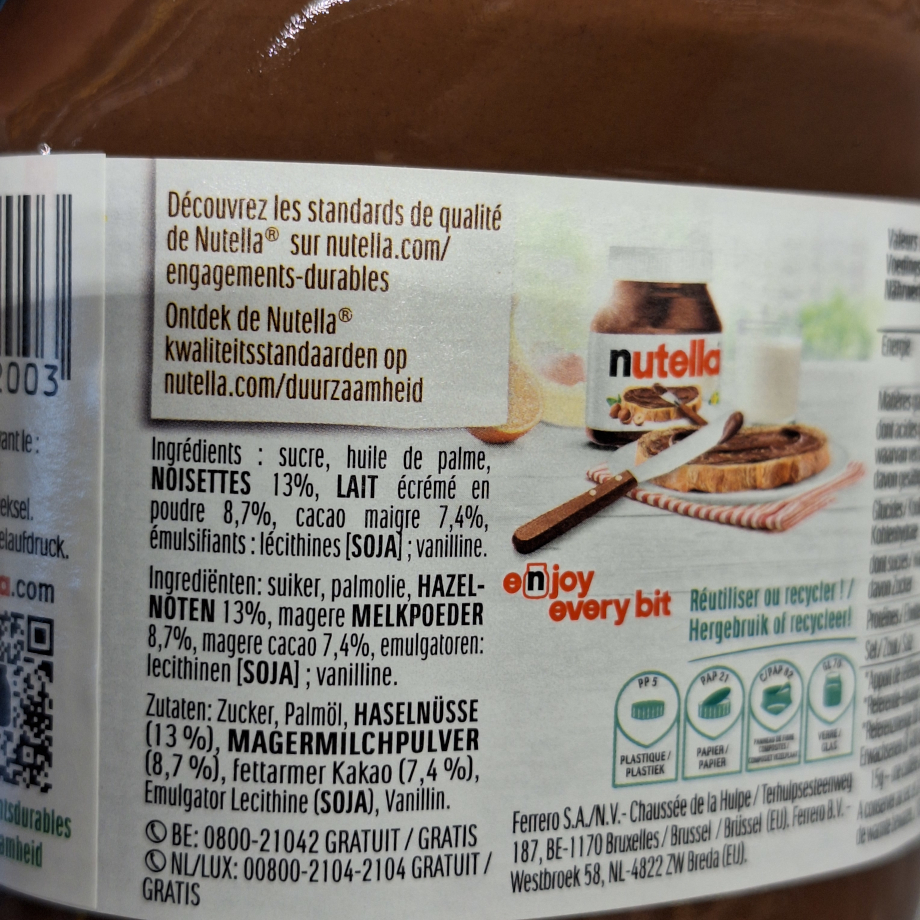
The list of ingredients on the label of the classic Nutella on the shelves in Belgium is clearly legible.
And then there was the plant-based version
Nutella therefore belongs to that category of products that are a veritable threat to public health and really shouldn’t be considered food. Unless, of course, we lower the bar yet again and, for example, shrug our shoulders and regard the rampant rise in childhood obesity as ‘the new normal’.
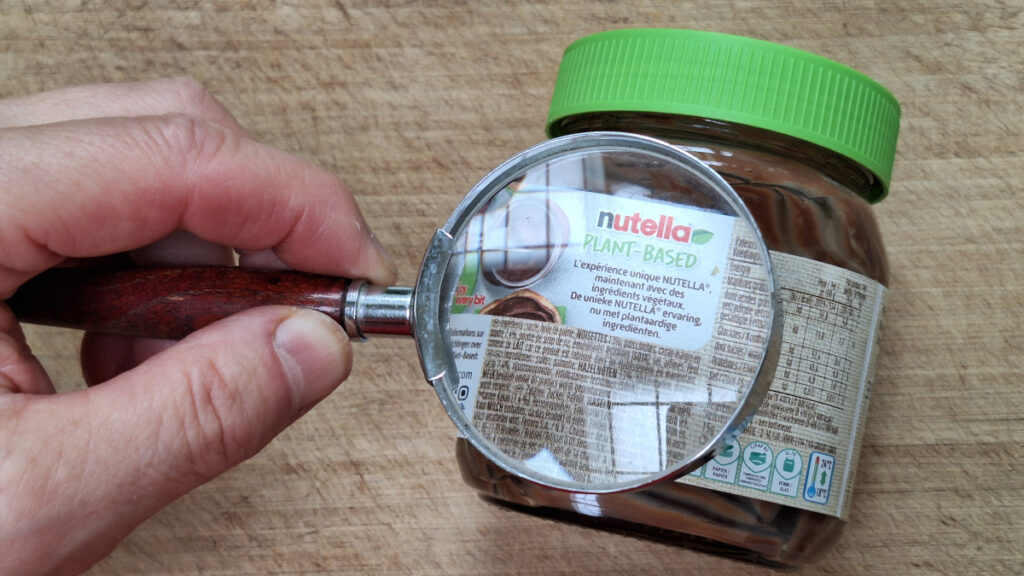
Now let’s take a closer look at the plant-based alternative to this junk food. Yes, you’ll need a magnifying glass. Because the label on the vegan Nutella on Belgian shop shelves is literally u-n-r-e-a-d-a-b-l-e. It’s an ultra-small, condensed font printed in brown on top of a brown background (which suggests a jute fabric). Tough luck for vegans, who, more than anyone else, need clear, legible information about the food they buy.
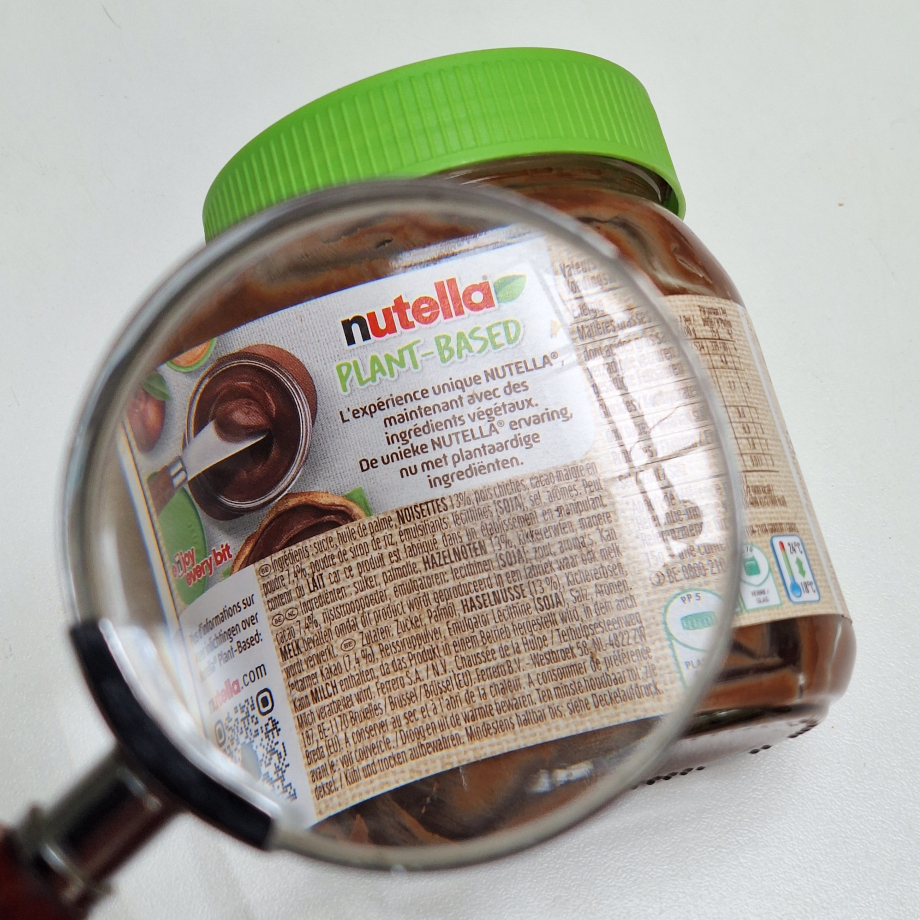
A closer look reveals – albeit with some difficulty – that the vegan Nutella has virtually the same basic composition as the classic version, with milk listed only as a possible trace ingredient and replaced by chickpeas (or chickpea ingredients?). Rice syrup is also listed here, along with the – inevitably vague and enigmatic – ‘flavourings’. Read that last bit as ‘unidentified artificial additives’ that help to biochemically hook you, the consumer, on the product.
In short: pretty much the same rubbish as the classic version, but without the milk.
An enlightening little calculation
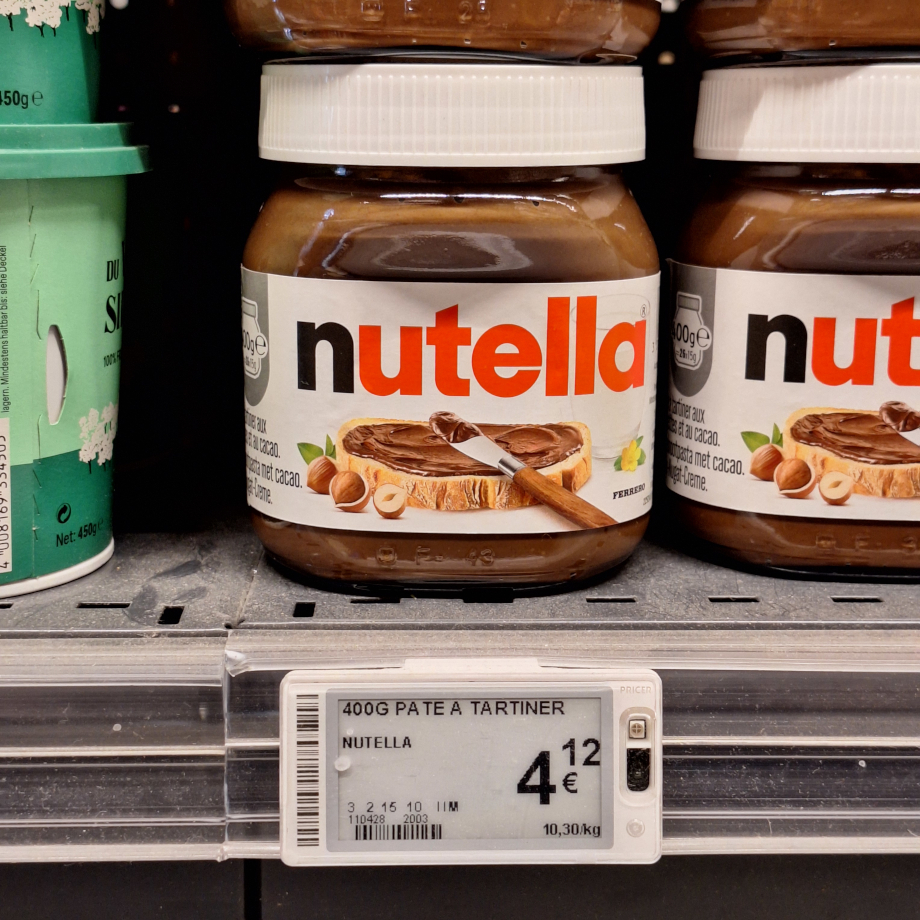
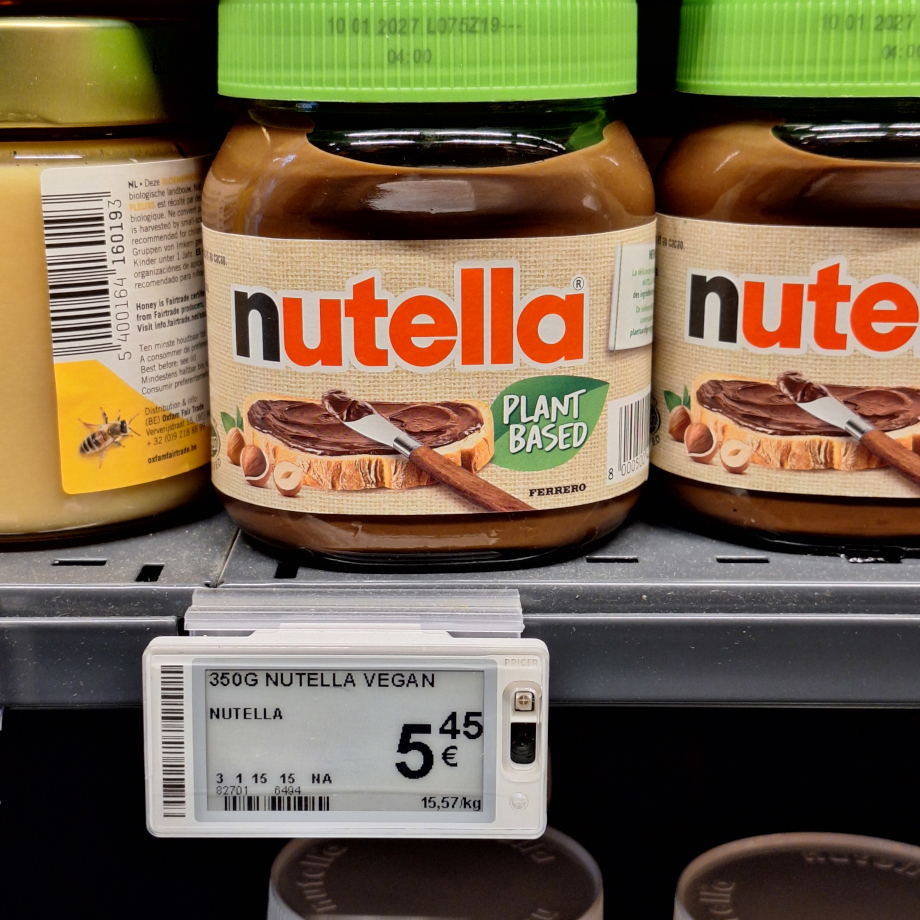
Let’s take a look at the price: in a randomly selected belgian supermarket, in August 2026, we find the classic Nutella priced at 4.12 euros for 400 g, which works out at 10.30 euros per kilogram. The plant-based version is on sale at 5.45 euros for 350 g per jar. The price per kilogram of the vegan version in this shop is no less than 15.57 euros. See the comparison table below. In other words: it’s half as expensive again as the classic version. Prices vary from supermarket to supermarket, but the price difference between the classic and the vegan versions is proportionally just as large there too. Note the subtle difference in weight between the contents of the two jars, which nevertheless look the same size. This suggests a deliberate creation of illusions – in other words, deception.
| Kind of Nutella | Weight | Price store 1 | Price store 2 | Price/kg store 1 | Price/kg store 2 |
|---|---|---|---|---|---|
| Classic | 400 g | 4,12 € | 3,59 € | 10,30 € | 8,97 € |
| Plant-based | 350 g | 5,45 € | 4,85 € | 15,57 € | 13,86 € |
Is that fair or not?
Is that price difference justified? Let’s do the maths again. The 8.7 per cent milk powder in the classic version corresponds to a quantity of approximately 34 g. Standard milk powder costs, at the retail price, around 18.00 to 20.00 euros per kg. Assuming that the vegan version contains a roughly comparable 9 per cent of chickpeas, this corresponds to a weight of approximately 31.5 g. Raw chickpeas cost, on average, around 5.00 euros per kg. Cooked chickpeas and chickpea flour are slightly more expensive, at 6.00 euros and 9.00 euros per kilogram respectively. If we work all this out, the milk powder amounts to approximately 0.65 euros per jar in terms of value, compared with 0.24 euros per jar for the chickpeas …
As might be expected, this does not in any way justify the price difference between the animal-based and the traditional versions; quite the opposite, in fact.
Contempt for outsiders
And that’s a real slap in the face for plant-based consumers.
Chickpeas are therefore clearly by far the cheapest raw material. Furthermore, the cultivation of chickpeas has a particularly low environmental footprint. In contrast, cattle farming and the dairy industry place a particularly heavy strain on the environment and ecosystems.
That alone should be reason enough to do away with classic Nutella immediately and replace it with the plant-based version. At least for those who still want to keep poisoning themselves or their children with massive doses of refined sugar.
This just goes to show how most of these vegan ‘junk food’ alternatives are yet another example of the deep contempt that the food industry effectively harbours for people who, for various reasons, do not simply toe the line.
Choose the best Nutella
For the average consumer with no prior knowledge of nutrition (and that is the vast majority), the vegan version is perceived as the more expensive, luxury version of Nutella, which offers no added value whatsoever and which they will therefore give a wide berth. This product simply reinforces the cliché that: plant-based = expensive.
Only consumers who are often slightly better educated and have a more developed sense of awareness might be willing to part with their money for this product. And these consumers are, in effect, regarded as a cash cow. A limited segment of ‘difficult’ consumers, who pay dearly for their critical thinking.
You’d have to be a masochist to want to buy this product. We’d be better off spending our money on healthier and more ethical alternatives. Because, on top of all this, Nutella’s owner, the multinational Ferrero, has a very poor track record when it comes to the environment, social justice and health.
Without a doubt, the best Nutella is the one you leave untouched.